a wandering woman writes

Tuesday, August 07, 2007

The music of time


There is something, a type of memory, I don't quite know what, a background noise, a music, barely perceptible, perhaps, but it is as if in the darkest, most well hidden heart of a house everything that happened in the house has remained there, molded, shaped. As if the house harbored in a musical score the meter of the sobs and of the happy times. The adagio of a lament. The andante of a dream. Now and then the tamborilero of the joys and the laughter. And abruptly, the hard blow. And now and then the silences. Also the silences. You open the door and there it is, the full symphony, and suddenly you let yourself be carried from smell to smell, from sound to sound. From sensation to sensation. The music of time.


The quote is (translated by me) from a gorgeously lyrical book, Utilidades de las Casas, by Isabel Cobo. I loved it when I read it, and somehow my recent trips to little places - La Alberca, Prats de Mollo, Mogarraz - brought it to mind. Small towns have a similar kind of memory, don't they?

Labels: ,

Tuesday, October 31, 2006

The Meaning of it all -- and my bookshelf

Some people say, "How can you live without knowing?" I do not know what they mean. I always live without knowing. That is easy. How you get to know is what I want to know.

Richard Feynman (Nobel Prize winning theoretical physicist), The Meaning of It All: Thoughts of a Citizen Scientist


A last minute day trip to El Corte Ingles in Madrid last week didn't yield the perfect outfit for the super-wedding I attended Saturday. Even so, it did prove that Madrid is an easy daytrip by train. And I returned to Salamanca with a good supply of all those things one's mother usually gives at Christmas and 3 new tenants for my overcrowded bookshelves.

I love the small independent bookstores in Salamanca, especially Victor Jara and Cervantes. But oh! there is nothing like a rainy afternoon spent browsing the bargain tables in El Corte Ingles or the Casa del Libro in Madrid.

This trip I picked up:

El Placer de Descubrir: a translated collection of Richard Feynman essays and interviews. Feynman is a lost long love from my scientist days: a bongo-playing, ant-watching (Nobel-winning) theoretical physicist who wrote and spoke from the cuff about anything and everything.

An 800 page guide to "select" Spanish pueblos. 800 pages!! Yippee, I say, although far I've only frustrated myself trying to figure out how to catch a bus to Madrigal de la Altas Torres, birthplace of Isabel I. This book will either deliver great blog posts or torture me about my lack of a car.

A mere 400 page history of Spanish monarchs from the Middles Ages to the present. I'm tired of missing monarch references and scratching my head to remember who's who. I'm hoping it will be a good companion as I wander the castles and convents of the 800 pages of pueblos.

Other than the guide to pueblos, these new acquisitions will squeeze their way onto shelves and wait their turns behind a Freya Stark (A Winter in Arabia) I picked up in Hay-on-Wye, Paul Hyland's Backwards out of the Big World, the history of jazz in Spain my coworkers gave me as a going away gift, Ian Gibson's biography of Antonio Machado and Ghosts of Spain, recommended by Alex.

Whatever you do, favorite bloggers, please don't recommend books for a while...

Labels:

Thursday, September 07, 2006

A Walk in Hay

If I learned one thing in Wales, it was this:
Wales is not England.

I was warned by more than one person that Hay is not a particularly "Welsh" place. I'd need to dive deeper into Wales to truly experience "Welshness".


Still, everyone I spoke to in Hay and surrounding towns, even the Welsh-born potter with whom I spent a few days in East Anglia at the end of my trip, made sure I understood one thing: They were Welsh, not English. Not English just as my Irish ancestors were not English, I was told.

And so as I trekked along several of the walks published by the tourism office, I repeatedly crossed the border. "YOU ARE NOW LEAVING WALES", my walking directions would suddenly shout out in harsh capital letters. "YOU HAVE NOW ENTERED ENGLAND".


A warning? A welcome? A bit of geographical trivia for hikers? I got the quiet sense it was much more. I've come to no conclusions, but you hear this idea of nations within a nation, whatever word you use, in lots of conversations in Spain these days.


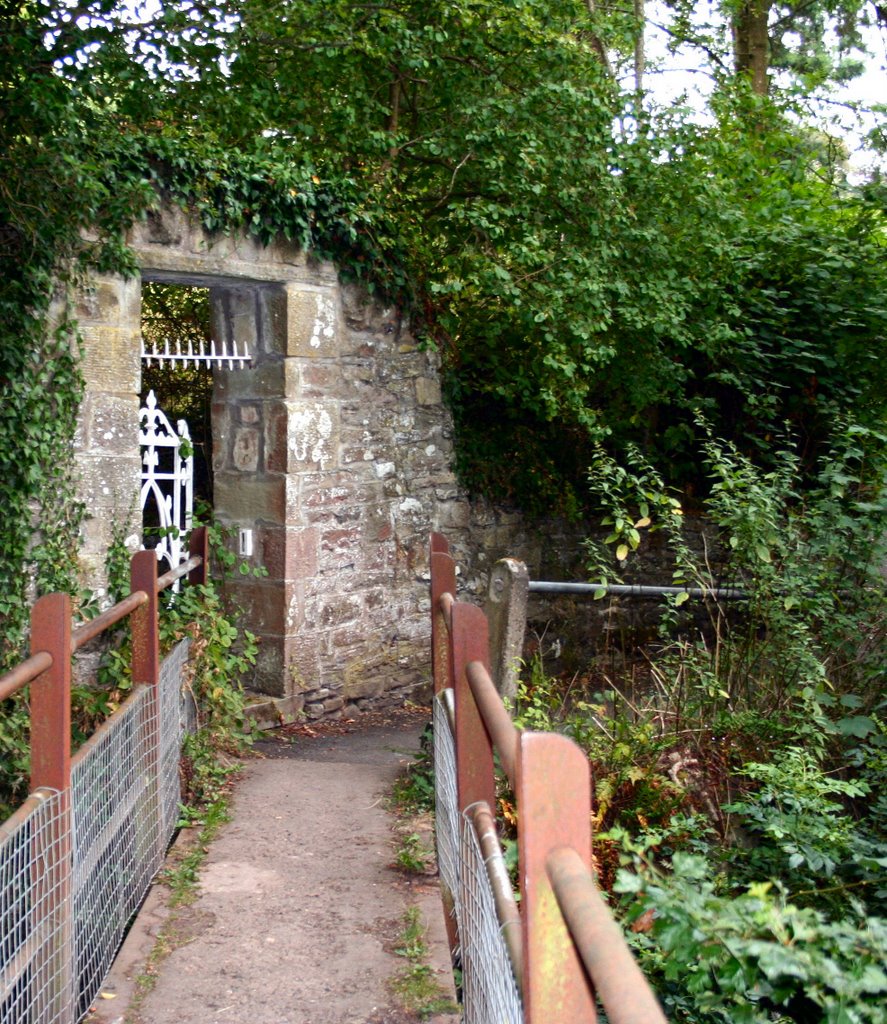
My border crossings were quiet bridges over a stream.


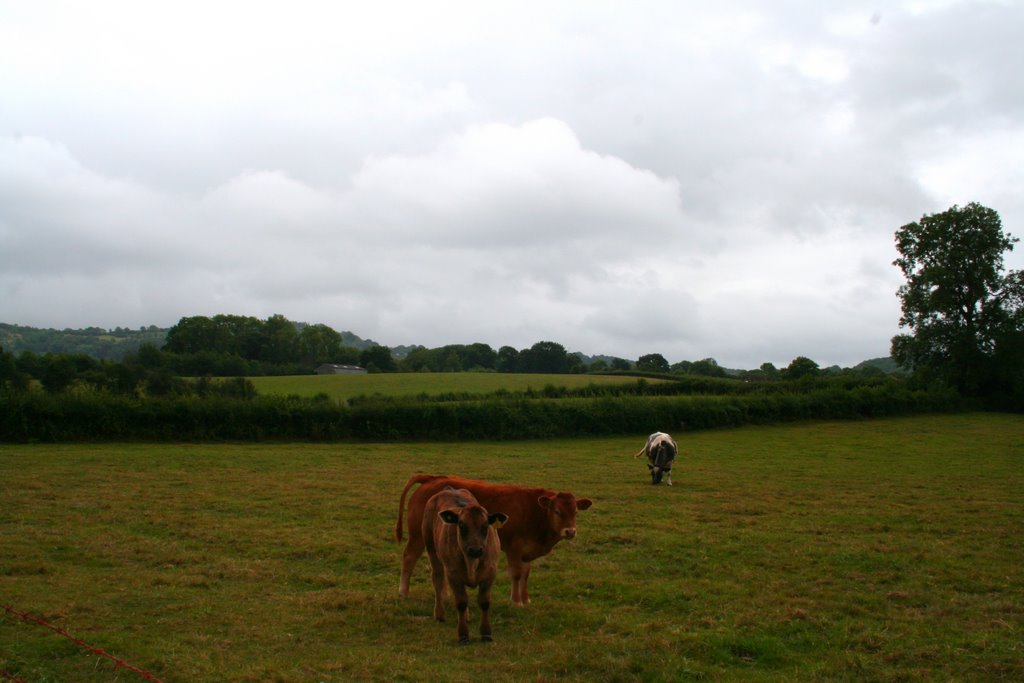
My company was mostly ovine, and occasionally bovine.


I arrived in sandals and wished for Wellies. Aside from that self-imposed discomfort (who knew I'd wind up walking in Wales?) walking in the countryside around Hay, and Brecon, a neighboring town, was a damp, full-bloom treat.

Labels: ,

Wednesday, September 06, 2006

Mary Lee Settle, on Spain


"To be alone by choice is one of the great luxuries of the world. I went to Spain alone."

Mary Lee Settle, "Spanish Recognitions"


I was bound to love a book with that opening line, wouldn't you say?

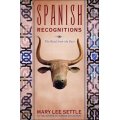
One of the books I picked up in Hay on Wye was a paperback copy of Spanish Recogitions by an American novelist, Mary Lee Settle, author of an acclaimed (so the book jacket tells me) book about her wanderings in Turkey called "Turkish Reflections."

At 82 years old, Mary Lee Settle flew into Madrid, hired a car and started out in "search of Spain." An ambitious project, but she winds up doing what we'd expect a history buff with an interest in Turkish culture to do: following the path of history in her rented car. She traces the Moorish conquest of Spain sweeping north, then the Christian reconquest in the other direction. Along the way she ponders Penninsulan wars I'd never heard of, but now recognize in Salamanca street names. She looks briefly at the Civil War, in Madrid and later in Granada, with the eyes of a woman who remembers it, who had an opinion as it happened in the 30s, and who knew young Americans who came to Spain to fight with the Republican forces.

I left this book with a long list of people I want to know more about, history I want to dive into, and places I want to visit. I will do all of that, in Spanish. Settle doesn't speak Spanish, and, despite having read extensively before visiting, isn't always academically straight-on in her history. The Amazon page includes a post by a reviewer who loved the book, but hopes a new revised edition will straighten up some historic references, questionable translations, etc.

So why does the reviewer who chronicles Settle's every error love the book? Why do I?

Because Mary Lee Settle writes lovely, lyrical prose. And she's my kind of traveller:

I had all day to roam. After all, I was alone, and almost asking to get lost. I was looking forward to discovery, not to being tied to that deadening word, itinerary. How can you know ahead what you are going to see, find, lose, discover any more than who you are going to fall in love with the day after tomorrow?


She finds duende in Salamanca's Plaza Mayor. Despite not speaking the language she "meets" my Spanish neighbors, and I recognize them. On the Sunday morning she arrives in Salamanca, an older man leaves his wife with the newpaper and baked goods they just picked up in town, climbs off the Gran Vía into the passenger seat of Settle's car, and guides her to her hotel with hand signals. When the 82 year old stranger doesn't understand his directions in Spanish, he escorts her to her hotel before heading home to his wife and newspaper.

She joins the nightly paseo in the cities and pueblos she visits, and calls the Spanish "the most accomplished strollers in Europe". I'd add they beat any North Americans I've ever met, as well, but she is indeed on to something "Spanish". As she dives into the story of Juana la Loca, or Lorca, or Unamuno, or Teresa of Avila, or Isabel la Católica (yes, Americans, of Columbus fame) she walks through their "places" to get to know them, and she "recognizes" something "Spanish": a character, a history, a way of looking at the world, a set of beliefs and customs. She gets, as she writes in her final paragraph, "a half-caught glimpse of that essence which is Spain".

I closed the booking feeling like I'd met a new friend. Sadly, when I surfed away to locate her, I found instead her obituary in the Guardian and the Washington Post.

I'd hoped to write and thank her for resparking my own passion for wandering Spain, and for giving me a long Spanish reading list and a longer travel wish list.

Labels:

Monday, September 04, 2006

Running away to Wales - Hay on Wye

When the course that led me to England mysteriously lost its charm, I thought of an article I'd read in El País. Hay on Wye, the Welsh "town of books", was inhabited by less than 2000 people and more than 30 bookstores, according to El País. My kind of town.

I left Oxford and ran away to Wales.
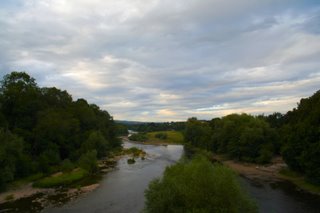
Hay-on-Wye borders England on its eastern and northern boundaries, and rests at the crossroads of two long distance footpaths - Offa Dyke's path, which runs the length of Wales, tracing the line of a barrier built by King Offa in the 8th century, and the Wye Valley Walk, which meanders its way through the spectacular Wye Valley along the course of the Wye River.
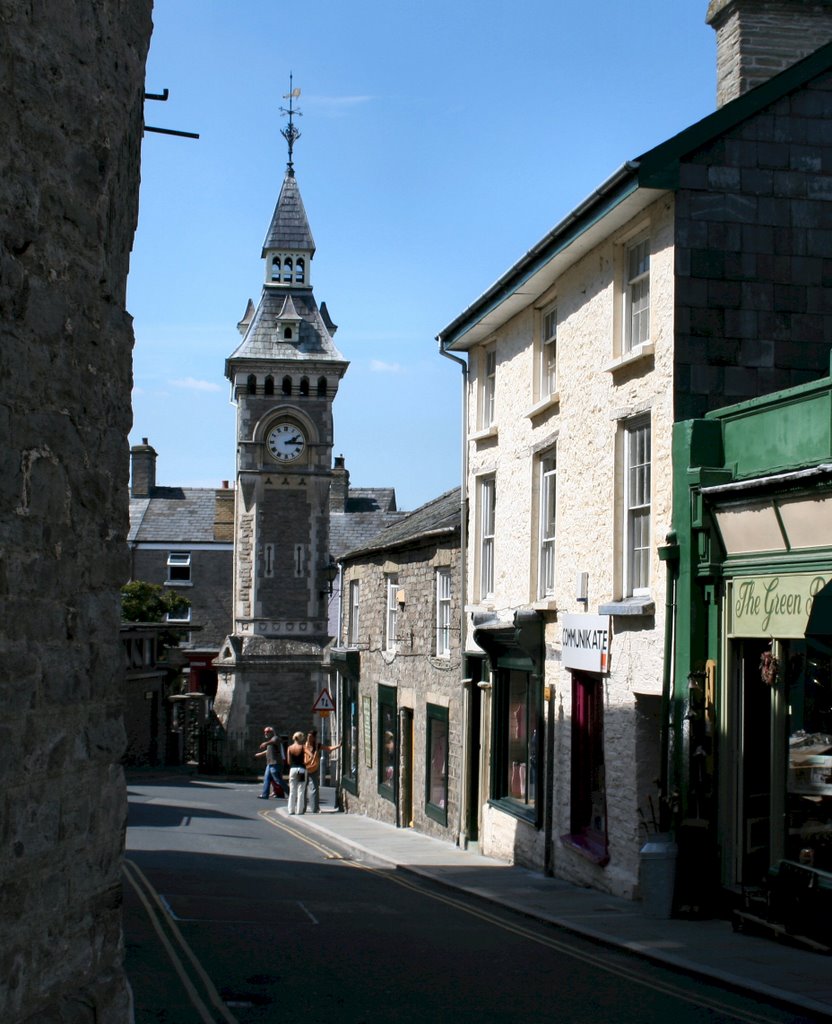
The tiny stone town is surrounded by glorious green countryside.


Hay on Wye earned the "town of books" title when a local man, Richard Booth, returned from college determined to create the largest second-hand and antiquarian book-selling center in the world. He succeeded.


He has since bought the town's crumbling Norman castle and crowned himself both "King of Hay" and "Emperor of the Book Towns of The World". Hay-on-Wye now lives from books, old maps, antiques and tourism, and Richard Booth owns the world's largest second hand book store.

I chatted at Oxford with an aspiring writer who had attended this year's Guardian Hay Festival of Literature, during which local townsfolk open their homes to the visiting speakers and authors. I've added the fest, held over a week in early summer, to my travel wish list.
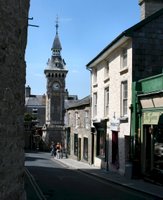

I went to Hay to walk, and read.

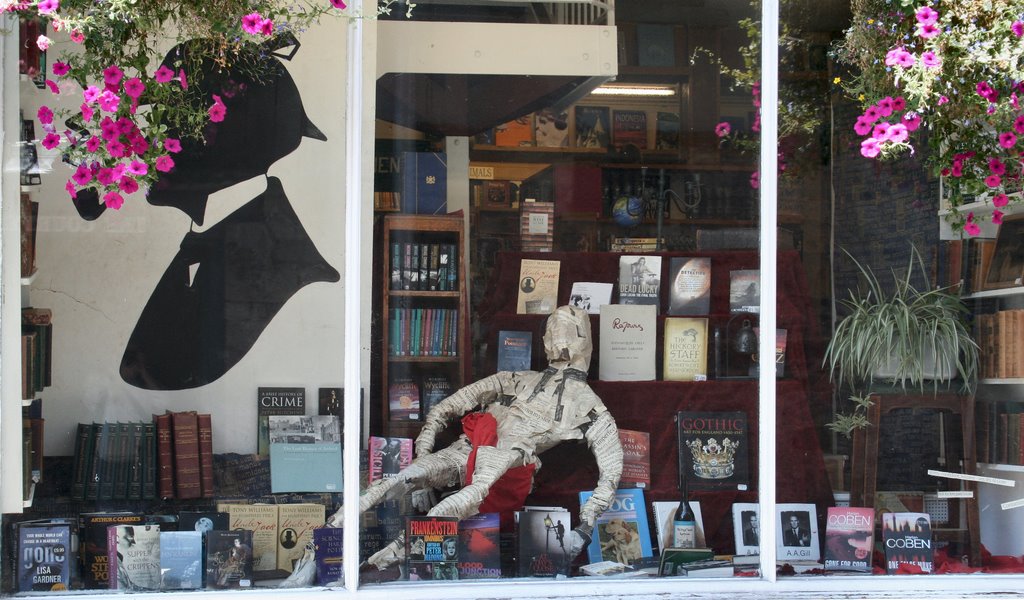
Hay's streets are indeed lined with bookshops: a few bright, modern, well-organized shops scattered amongst tiny pieces of Wandering Woman heaven, those dark, cool bookshops smelling of dust and dampness, where you blissfully fear for both your life and your book budget as you squeeze between overburdened bookcases, fruit crates full of yet-to-be-shelved treasures, and teetering stacks of magazines strewn about the floor. Inevitably the shop comes equipped with an bespectacled owner who can pull any book out of the chaos, instantly.
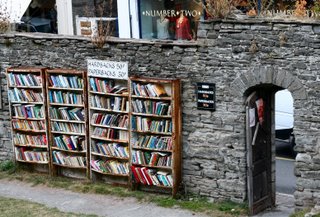


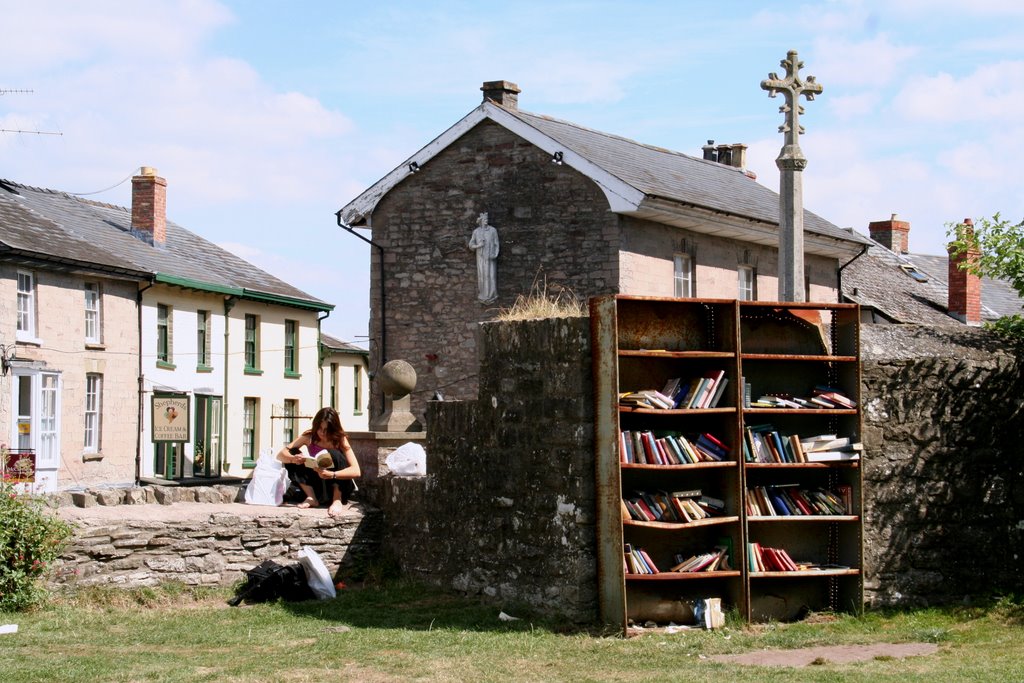
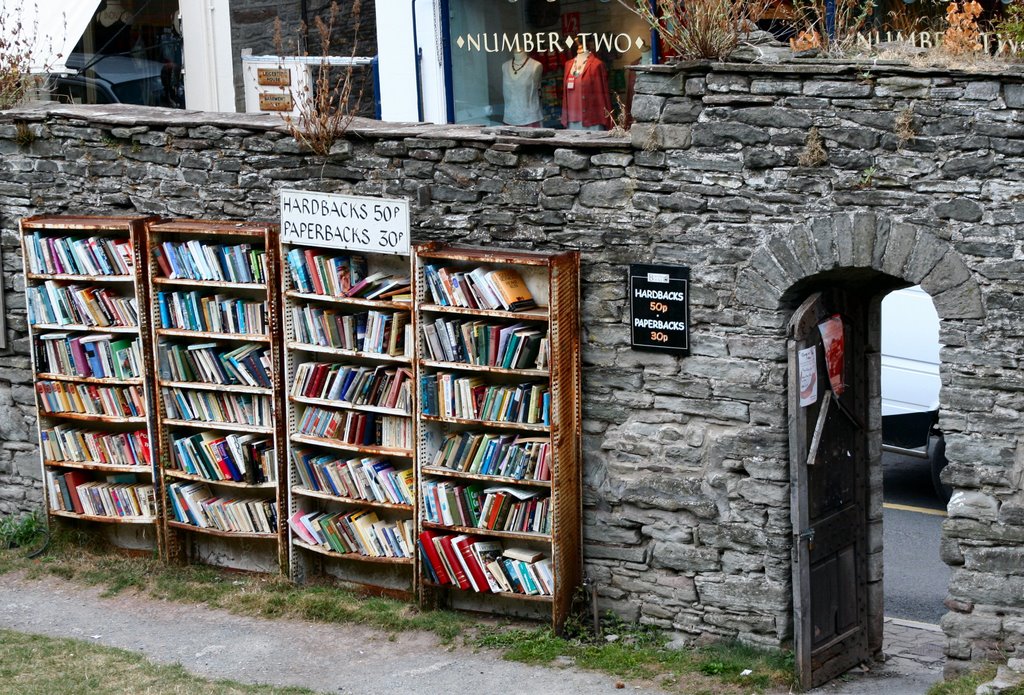
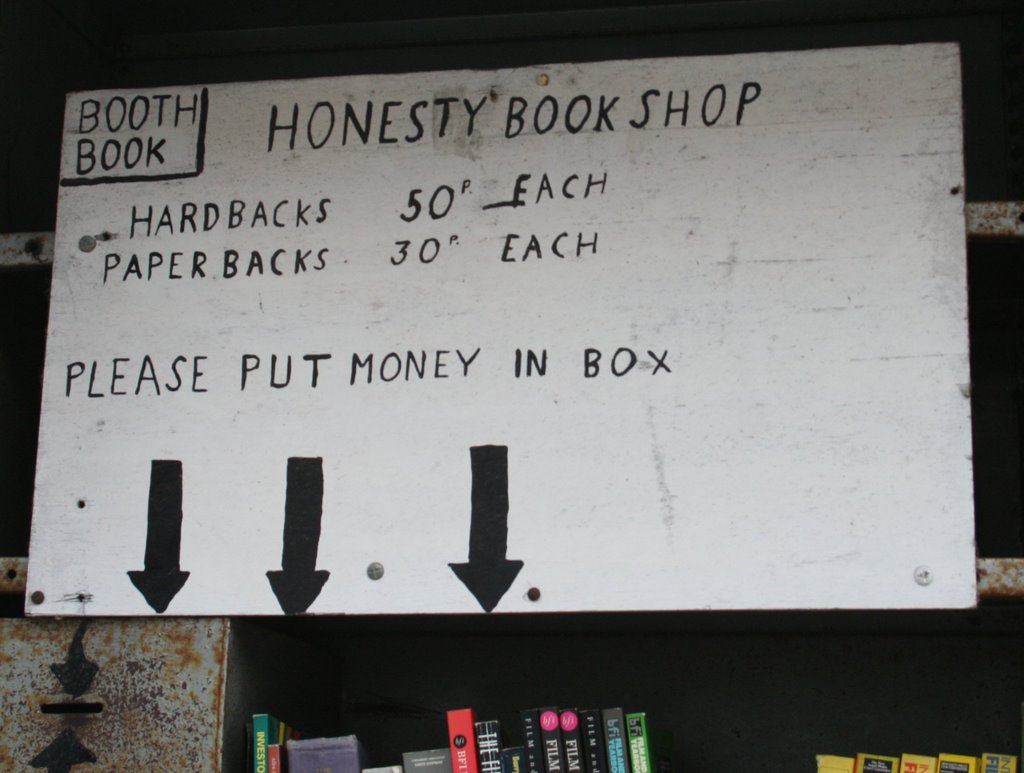
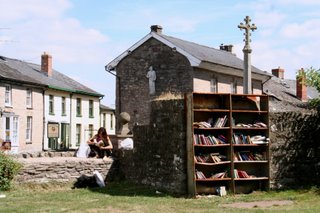
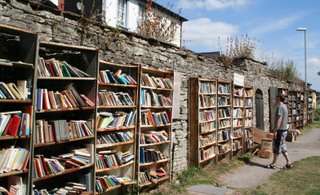
Even the walled grassy courtyard below the Castle is lined with book shelves. You won't find an attendant, just a a sign instructing you to leave your payment in the metal box, should you decide to take one of the weatherworn treasures home with you.


At an "honesty bookshop" housed in a metal lean-to just above the castle, I listened to a Spanish couple read English story books to their surprisingly rapt sons.
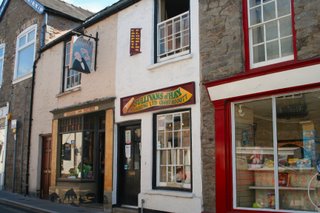

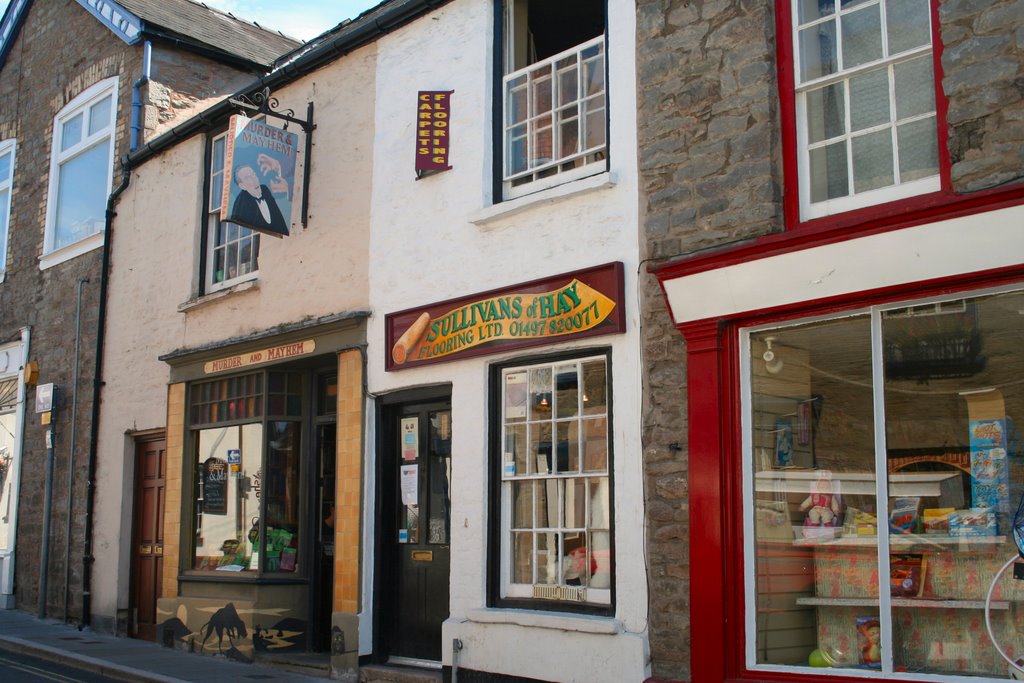
I looked up during a walk though town my first night and chuckled. A young woman was sitting on her window sill about the Murder & Mayhem mystery bookshop, window open, reading. A couple was reading in the brilliantly lit front room of their home, just a few houses down from my hotel. Great marketing or a lifestyle? I never did decide.
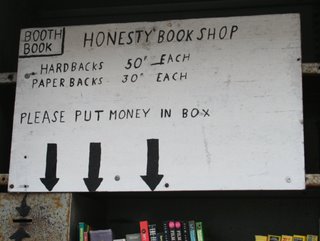


Books are everywhere. Two bookshelves grace the entrance to the rest rooms at Oscar's Cafe, where I feasted on cold poached salmon two days in a row. "These books are for sale", the sign tells customers impatient to advance in the rest room line. "Please pay at the desk." A woman recruited me to watch the books she'd chosen at my table, while she returned to her place in line.


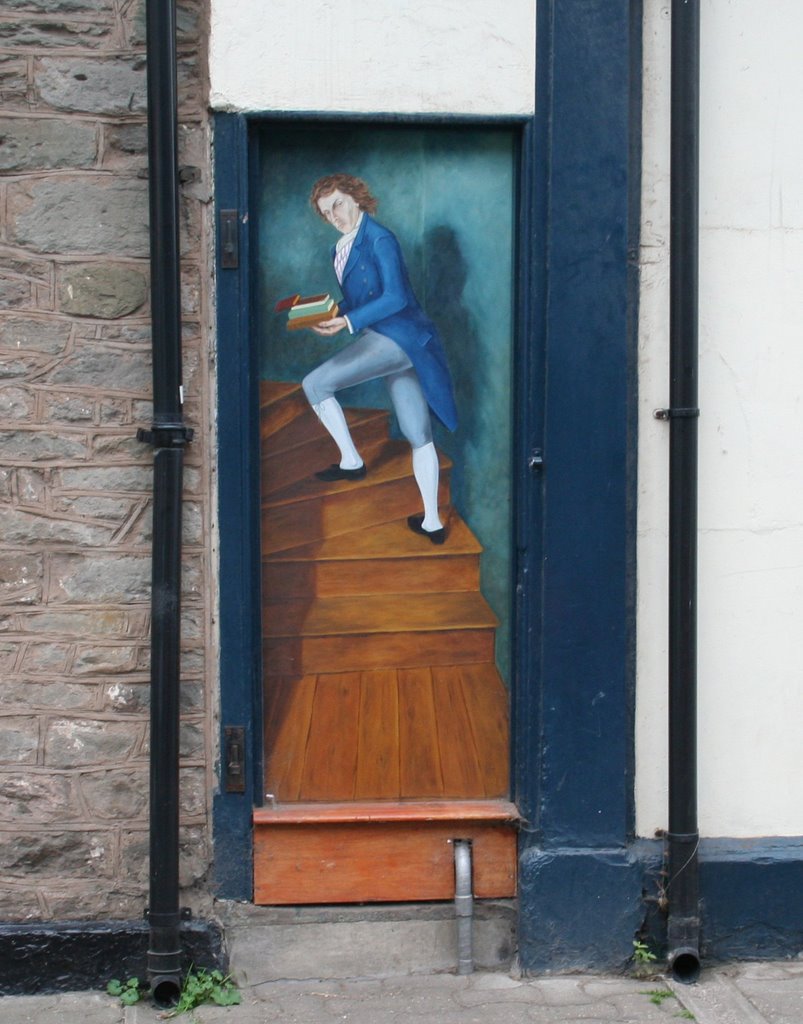
Hay gave book-loving, walk-craving me far too much for a blog post. Here are a few scattered images from my 5-day stay:
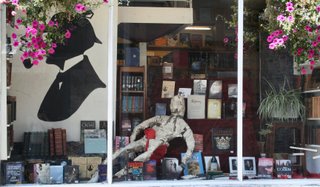

The rain the Spanish called llovizna: a soft mist that wets you everywhere, but to my mind makes perfect walking weather.

A very wise barman at the Swan at Hay Hotel, who looked over at my pub table for one, out at Wales' unusually clear skies, then back at me before making a brilliant decision. He ordered me to the garden and ordered the waitress to serve my dinner there. And so I enjoyed a delicious dinner and a tasty pint of the local Butty Bach while watching the sun set from an aromatic garden in Wales.
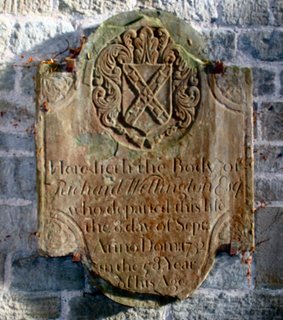

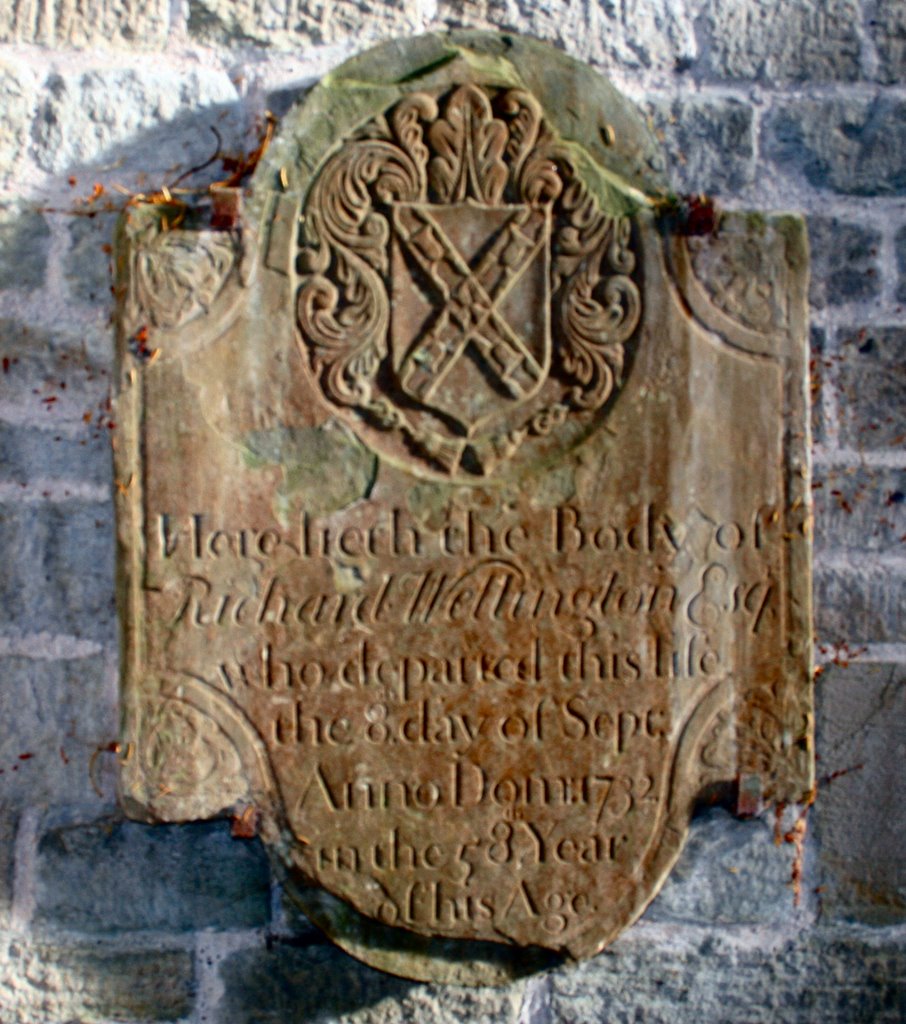
The pastor of Saint Mary's church, whose steely blue eyes, dark curls, and long black cassock looked straight out of The Thornbirds. He gave me a big friendly wave as I wandered his churchyard, snapping pictures of gravestones and stone figures. When he passed me in the street later that evening, he warmly invited me to visit the church and take all the pictures I'd like. A moment later I was "outed" when I pronounced "cemetery ". "The what?" he asked. "Ah, the cemetree. America is it?" He grinned at his friend. "I've heard of it. America. Somewhere abroad, yeh?"


Market day, complete with a portable fish store and a red-faced fruit man barking "Everybody try a peach! EVERYbody try a peach" at the top of his lungs. "Spectacular Peaches! Everybody step up and try a peach!" He was right; they were spectacular.


In a fun coincidence, although I won't be able to get there, Segovia is hosting its first Hay Literature Festival in late September.

Labels: ,